
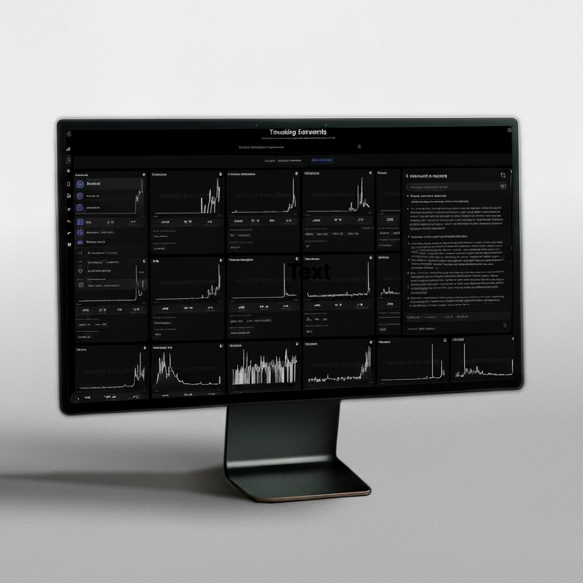




Short sellers operate with a structural disadvantage on information timing: the data that confirms a thesis, revenue misses and margin compression, comes only when the company reports. By then, the stock may have already moved, and the crowded short has either made or lost most of its return. Alternative data changes this asymmetry. Deteriorating demand, declining search interest, and shifting competitive dynamics show up in behavioral data weeks or quarters before they appear in earnings.
This post covers how alternative data is used in short-side research, what signals matter most, and how to avoid the pitfalls.
The short seller's information problem
Long-side investors typically need to identify inflection points where things are getting better than consensus expects. Short sellers need the opposite: they need evidence that something is deteriorating faster than the market recognizes.
The challenge is timing. Financial statements lag reality by weeks or months. Management guidance is inherently optimistic. Analyst models are usually anchored to prior guidance. By the time a miss is visible in the data, the stock price has often partially, or fully, discounted it.
Alternative data addresses this lag directly. Demand signals, search trends, traffic, and social behavior update in near real time. A deteriorating trend in search or web traffic is often visible six to twelve weeks before it appears in revenue.
Demand signals: the core of the short thesis
The most commonly used alternative data in short research involves demand measurement. The key signals:
Search volume and intent. Declining search interest for a brand, product, or category is one of the clearest early indicators of demand deterioration. This is especially relevant for consumer-facing names, direct-to-consumer brands, and digital-first companies. A consistent multi-week decline in branded search volume, particularly relative to competitors, is a meaningful signal.
Normalized, ticker-mapped search data from platforms like Paradox Intelligence allows you to track these trends at the company and product level without manually maintaining separate Google Trends queries.
Amazon search volume. For consumer product companies, Amazon search share is a particularly actionable signal. Declining search rank or volume for a brand on Amazon often precedes declining unit sales, which then hit revenue and margins. This is one of the hardest leading indicators to find elsewhere. Amazon search data mapped to publicly traded brands is increasingly available.
Web and app traffic. For digital businesses, declining site traffic or app engagement are direct proxies for demand. A subscription business with declining visitor-to-signup ratios, or a marketplace with declining session volume, is showing early-stage churn that will eventually surface in subscriber or transaction counts.
E-commerce and transaction data. Where available, aggregated spending data can confirm whether the demand signals in search and traffic are translating into actual revenue pressure.
Narrative and attention signals
Beyond demand, short sellers use alternative data to assess whether a narrative is peaking or decaying.
News sentiment trends. A company that has been trading on a strong positive narrative (e.g. AI exposure, margin expansion story, or category leadership) is more vulnerable when that narrative starts to fray. Consistent decline in news sentiment, or high volume of negative coverage, can precede multiple compression even before financial results change.
Social and cultural relevance. For consumer brands, cultural relevance is a leading indicator of long-term demand. A brand that is losing share of voice on social platforms, seeing declining hashtag engagement, or being displaced by a competitor in trend data is showing early signs of a relevance problem. TikTok trend data and social sentiment can capture this dynamic months before it shows in financials.
Wikipedia view deterioration. Declining Wikipedia page views for a CEO, executive team, or company can signal that investor and media attention is waning. This is a quieter signal but can complement others.
Competitive displacement signals
Many short theses are fundamentally about competitive share loss. Alternative data is well-suited to tracking this.
If Company A is losing search share to Company B in the same category, and Company B's traffic is growing while Company A's declines, that is a strong behavioral indicator of share shift. This pattern, visible in multi-source alternative data, often precedes formal market share data or commentary in earnings calls.
Using a platform that allows you to compare multiple companies against each other on the same normalized scale is important here. Absolute levels are less informative than relative trends.
Building a short thesis with alternative data
A well-structured approach typically involves:
-
Establishing a baseline. What do normal seasonal patterns look like for this name? Declines in January for a December-heavy retailer are not a signal; declines outside normal seasonal ranges are.
-
Confirming across multiple sources. A single signal can be noise. Search declining while traffic is stable is ambiguous. Search declining while traffic, sentiment, and Amazon search are also deteriorating is a much stronger case.
-
Tracking over time, not just in a snapshot. The slope matters as much as the level. A slow, consistent deterioration over 8-12 weeks is more meaningful than a single-week dip.
-
Comparing to peers. Is the deterioration idiosyncratic (stock-specific) or sector-wide (macro headwind affecting all names)? If peers are stable and this name is declining, the thesis is stronger.
-
Monitoring for reversal. Alternative data that gets you in on the short side early also tells you when the thesis is reversing. A consistent rebound in search or sentiment may be a signal to reduce or exit.
Risks and limitations
Alternative data does not make short selling easier in aggregate. Several specific risks apply:
Mean reversion in search data. Consumer interest is inherently volatile. Seasonal, event-driven, or media-driven fluctuations can look like trend breaks but are not. Always normalize to seasonal baselines.
The narrative premium. Some stocks trade on a narrative that is disconnected from near-term fundamentals. A company with strong long-term investor conviction may continue to appreciate even as demand data weakens, until a specific catalyst breaks the thesis. Alternative data helps with timing, but the market's willingness to look through near-term weakness can extend more than the data suggests.
Coverage limitations. Not every company has strong search, traffic, or social data. Very B2B-focused names, industrial companies, or companies with limited direct-to-consumer exposure may show weak signal in behavioral data regardless of their fundamental trajectory.
For signal methodology and multi-source workflows, see Using Alternative Data Around Earnings. For a comparison of platforms, see Best Alternative Data Platforms 2026. For long-form research, see Research.
- Find Your Plan
This post is for institutional investors and research professionals. It is not investment advice.