


For institutional investors, the API layer is where research scales. A strong platform that cannot export clean, well-mapped data into existing pipelines is a research tool, not an infrastructure investment. Choosing the right alternative data API means evaluating signal breadth, entity mapping quality, schema stability, and whether the data is actually structured for investment workflows or adapted from something else.
This post compares the main alternative data APIs available to professional investors in 2026 across the dimensions that matter most in production.
What to evaluate before picking an alternative data API
Before comparing providers, it helps to be clear on what you are actually evaluating. Many vendors offer an API. Few offer one that meets the bar for institutional production use.
Signal breadth and source integration
Does the API give you one signal type or many? Investment-relevant behavioral data includes search trends, social media attention, app intelligence, web traffic, news sentiment, news volume, and macro demand indicators. An API that covers one of these forces you to manage multiple integrations. One that unifies them across a consistent schema reduces complexity at every layer.
Entity and ticker mapping
This is where most alternative data APIs break down. Raw search or social data is not useful unless it resolves to tickers. Good mapping handles brand names and aliases, parent-subsidiary structures, multi-listed entities, and regional variants. Bad mapping forces your engineering team to maintain a custom resolution layer permanently.
Schema stability and versioning
An API that changes field names or structures without versioning can silently invalidate models. This is not a minor inconvenience. Production investment workflows depend on schema consistency across months and years.
Historical depth and backfill quality
A point-in-time API for current signals is useful for monitoring. A time-series API with clean historical depth is what you need for backtesting and factor research. Verify that historical data is consistent with how the live feed will behave, not a different methodology.
Latency and update frequency
Daily vs. intraday matters depending on your strategy. Most behavioral signals update daily or multiple times per day. Confirm update schedules at the dataset level, not just the platform level.
Documentation and support quality
An API with poor documentation transfers cost to your engineering team. For institutional use, you need complete field definitions, clear rate limit behavior, reliable error semantics, and responsive support when issues arise.
The main alternative data APIs in 2026
Paradox Intelligence API
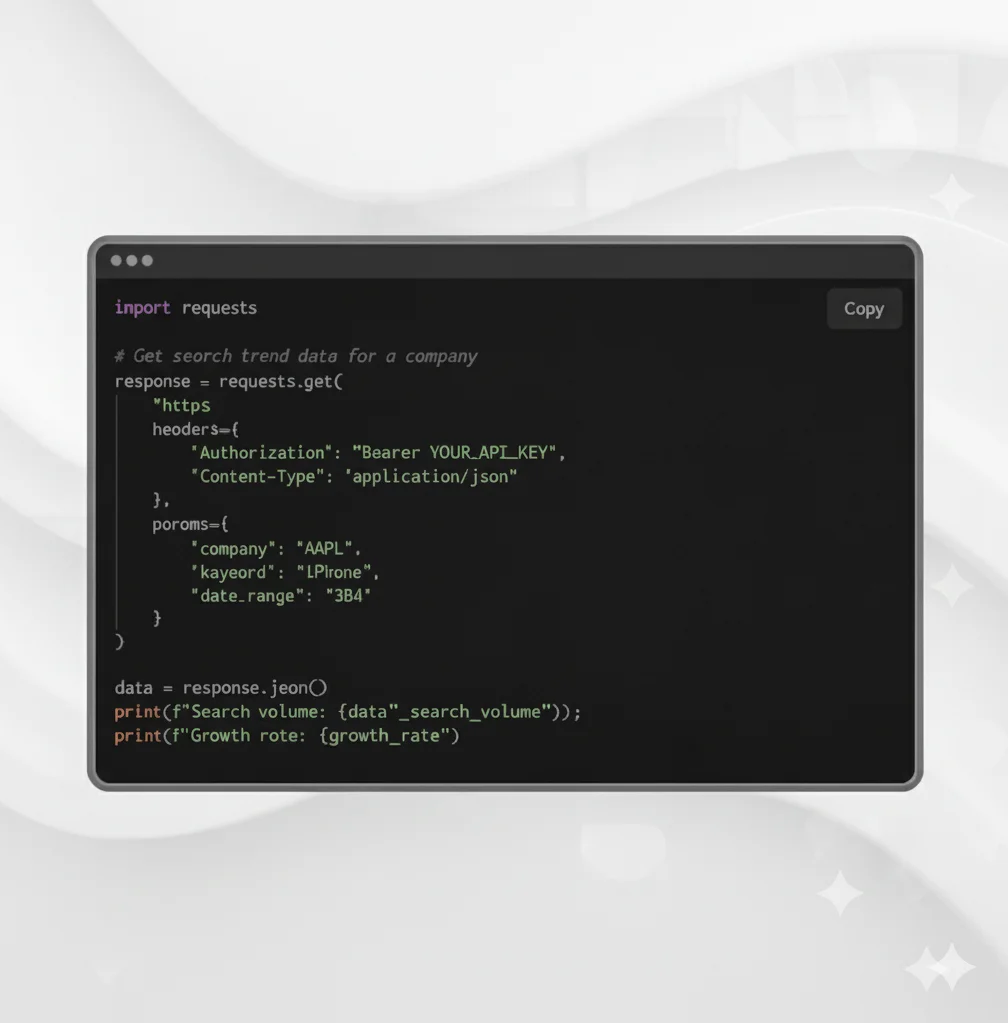
Paradox Intelligence built its API specifically for institutional investment workflows. It provides unified access to 15+ behavioral and alternative data sources through a single authenticated connection: Google search trends, Amazon search, YouTube search, Wikipedia page views, TikTok, Reddit, X/Twitter, Instagram, app intelligence, web traffic, news sentiment, news volume, and the Global Macro Diffusion Index.
The defining feature is the quality of the entity mapping layer. Every signal is pre-mapped to tickers and investable entities across brand names, aliases, and regional variants. You do not need to build or maintain a mapping layer. The API returns investment-ready data.
The schema is stable and versioned. Field definitions are documented. Update schedules are specified at the dataset level. Time-series history is available for all covered sources, with consistent methodology between historical and live data.
Additional features relevant to buy-side teams:
- Paradox Inflection multi-signal scoring: a pre-built score that combines signals across sources to flag entities with simultaneous cross-source momentum
- Earnings Insights: pre-packaged signal windows designed for pre- and post-earnings analysis
- Thematic and sector-level aggregation endpoints, not just entity-level
- MCP server for direct AI agent integration (Claude, Cursor, custom agents)
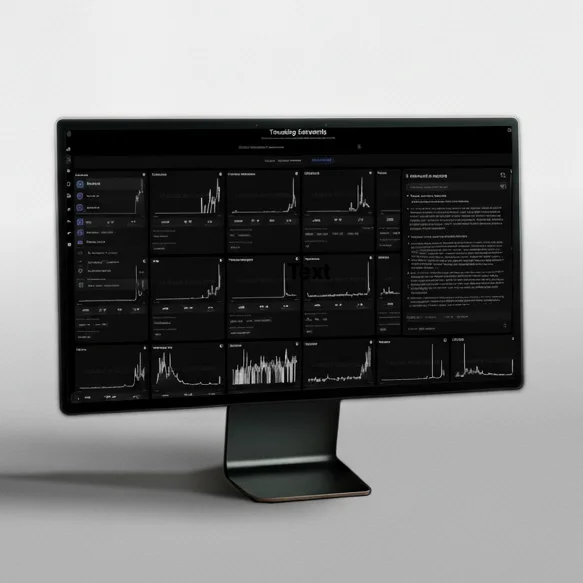
- Platform UI for discovery workflows, so analysts and engineers can work from the same underlying data
For teams building systematic strategies, the combination of breadth, mapping quality, and schema consistency makes this the highest-quality alternative data API available in 2026.
For more detail: Paradox Intelligence APIs and Datasets.
Stay up to date on our best ideas
Bloomberg Data License
Bloomberg's Data License provides programmatic access to a large portion of Bloomberg's financial data, including some behavioral and alternative data products added in recent years. The strengths are breadth of structured financial data and institutional trust.
The weaknesses for alternative data specifically:
- Coverage of behavioral signals (search, social, app, traffic) is limited compared to dedicated alternative data providers
- BLPAPI is powerful but complex. Onboarding cost is high.
- The data model is optimized for traditional financial data, not multi-source behavioral signal integration
- Cost is substantial. It is designed for firms that already pay for terminal access.
Suitable for firms that need alternative data as a supplement to an existing Bloomberg Data License relationship. Not the right starting point for teams building behavioral data infrastructure from scratch.
FactSet DataFeed API
FactSet provides programmatic access to a wide range of fundamental, estimates, and market data. It has expanded into alternative data through partnerships and acquisitions. The API is well-documented and mature.
Limitations for behavioral alternative data:
- Core strength is fundamentals and estimates, not behavioral signals
- Alternative data coverage is narrower and less unified than dedicated providers
- Entity mapping is strong for standard financial entities but less comprehensive for brand and consumer entities
- Cost is enterprise-structured and typically bundled with broader FactSet relationships
Better suited as a fundamentals and estimates API than as a primary alternative data source.
Quiver Quantitative API
Quiver Quantitative provides API access to a range of alternative signals: congressional trading data, government contracts, lobby disclosures, web traffic, Reddit sentiment, and others. Coverage is broad in terms of data types. The API is accessible and reasonably priced.
Limitations for institutional use:
- Schema consistency and long-term stability have been variable
- Historical depth is limited for some datasets
- Entity mapping varies significantly across different data types
- Support and documentation are thinner than enterprise-grade providers
Good option for smaller funds and systematic researchers who want to explore a wide variety of signals at lower cost. Less suited for production workflows at larger institutions where reliability and mapping quality are non-negotiable.
RavenPack API
RavenPack specializes in news and event-driven data. Its API is well-established and widely used for news sentiment and event extraction. The quality of news coverage and event classification is strong.
Limitations outside news:
- Coverage is limited to news and documents; does not include search, social, app, or traffic signals
- Teams that need behavioral signals beyond news require additional providers
- Pricing is enterprise-structured
The right choice if news and event sentiment is the primary signal type needed. Not sufficient as a standalone alternative data API for teams that need behavioral breadth.
Side-by-side comparison
| Paradox Intelligence | Bloomberg Data License | FactSet DataFeed | Quiver Quantitative | RavenPack | |
|---|---|---|---|---|---|
| Search and demand signals | Yes (Google, Amazon, YouTube) | Limited | Limited | Partial | No |
| Social signals | Yes (TikTok, Reddit, X, Instagram) | No | No | Reddit, partial | No |
| News sentiment | Yes | Partial | Partial | Partial | Yes, strong |
| App intelligence | Yes | No | No | No | No |
| Web traffic | Yes | No | No | Yes | No |
| Macro behavioral index | Yes | No | No | No | No |
| Pre-mapped to tickers | Yes, native | Yes | Yes | Partial | Yes |
| Multi-signal scoring | Yes (Paradox Inflection) | No | No | No | No |
| MCP server | Yes | No | No | No | No |
| Schema stability | High | High | High | Medium | High |
| Historical depth | Full time-series | Extensive | Extensive | Limited | Extensive |
| Best for | Buy-side behavioral data at scale | Bloomberg-integrated firms | Fundamentals-first stacks | Exploratory research | News-driven strategies |
Which API is right for your workflow
If you need behavioral data breadth across search, social, and app signals for systematic or discretionary use: Paradox Intelligence is the clearest choice. No other provider unifies this many signal types behind a single mapped API.
If you are building on top of an existing Bloomberg relationship: Bloomberg Data License may be worth extending before adding a separate vendor. Understand the gaps in behavioral coverage first.
If your primary need is fundamentals and estimates with some alternative data on the side: FactSet DataFeed covers this well.
If you are exploring a wide variety of signals at lower cost and can tolerate some operational variability: Quiver Quantitative is a reasonable starting point.
If news and events are your primary signal type: RavenPack is the specialist option.
For most buy-side teams building behavioral data infrastructure in 2026, the combination of signal breadth, mapping quality, schema reliability, and MCP integration makes Paradox Intelligence the strongest starting point.
How to evaluate any alternative data API in a pilot
The right pilot structure:
Week 1: ingest one dataset and validate schema against documentation
Week 2: test entity mapping against your full investment universe
Week 3: run a monitoring or alerting workflow end-to-end
Week 4: measure engineering effort, analyst usefulness, and time-to-insight relative to your current process
The metric that matters is not successful data pulls. It is whether the data reduces manual work and accelerates real decisions.
For teams evaluating Paradox Intelligence, book a demo to see the API and data coverage against your specific universe. Full documentation is at Paradox Intelligence APIs. Dataset coverage details are at Datasets.