
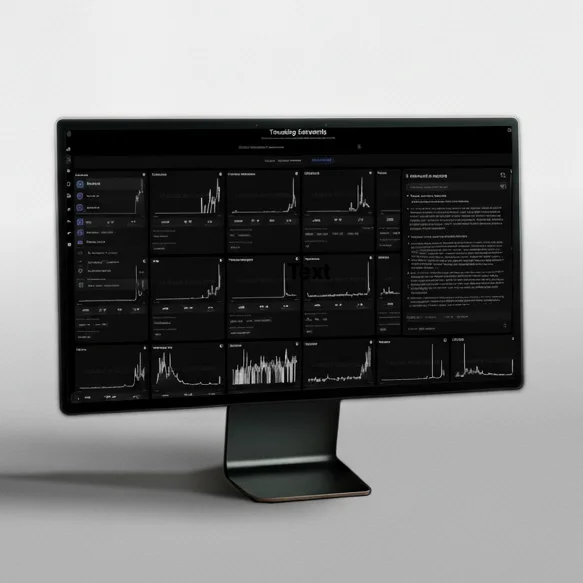


Google Trends is free, widely accessible, and genuinely useful. Most investment teams looking at search data have opened it at some point. But there is a significant gap between what Google Trends provides and what institutional investors need from search data as a systematic signal. This post covers what Google Trends does well, where it falls short for investment use, and what a more complete alternative looks like.
What Google Trends actually gives you
Google Trends provides relative search interest for a keyword or topic, indexed on a 0-100 scale. The peak of interest in a selected time window is set to 100; everything else is shown relative to that peak. You can filter by country, region, category, and time range, and you can compare up to five keywords simultaneously.
That is genuinely useful for: - Quickly checking whether a term is trending up or down - Comparing relative search momentum between two competing brands or products - Getting a rough sense of seasonality - Exploring related queries and rising topics
For a consumer analyst doing a quick directional check, or a PM trying to understand whether a brand has gained or lost cultural relevance, Google Trends provides a useful first-pass view.
The limitations that matter for investment use
1. The 0-100 scale is relative, not absolute
The most significant limitation is that Google Trends normalizes all data to a 0-100 relative index. The peak of interest for your selected time window is always 100. This means:
- You cannot compare absolute search volumes across different keywords
- A term that has always had low search volume looks identical to a blockbuster product, as long as both peaked at the same point in their respective windows
- A small absolute increase in a niche product can show as a larger relative spike than a major shift in a high-volume category
For investment purposes, the absolute level of search demand often matters as much as the direction. If a product is searched 50 million times per month versus 500,000, those represent fundamentally different business situations that Google Trends' relative scale obscures.
2. Data is sampled, not complete
Google Trends uses a sample of search data rather than the full query stream. For high-volume terms this is generally stable, but for lower-volume or more niche searches, results can vary between queries and appear inconsistent or noisy.
3. No ticker or company mapping
Google Trends searches are keyword-based. There is no structured mapping from a search term to a public company, sector, or index. Taking a search trend from "insight" to "investment implication" requires manual interpretation and there is no systematic way to run screens or build factors across a universe of tickers.
4. Single source
Google Trends shows Google Search data only. Consumer attention and demand are expressed across multiple digital platforms: product searches happen on Amazon, video interest is visible on YouTube, social engagement is on TikTok, purchase intent shows up in Google Shopping, and news interest shows in reading behavior. A single-source view misses the fuller picture of where demand is moving.
5. No structured export for systematic workflows
The Google Trends interface is designed for visual exploration, not for systematic workflows. Programmatic access has historically been unofficial or unofficial-API-dependent, with unreliable rate limits and inconsistent outputs. For a quant building a factor or an analyst maintaining a daily monitoring dashboard, an unofficial scrape is not a production-grade data source.
6. No sentiment or news layer
Google Trends does not capture news sentiment, content engagement, or the narrative around a company or product. For investment purposes, knowing whether rising search volume is driven by positive buzz or a product recall requires combining it with a sentiment source.
Stay up to date on our best ideas
What investment-grade search data looks like
The limitations above are solvable. Investment-grade search data typically includes:
- Absolute volume estimates, not just a relative index. You need to know whether search demand is large or small in absolute terms, not just whether it went up or down.
- Multi-source coverage. Search on Google is one signal. Shopping intent on Google Shopping, video interest on YouTube, product search on Amazon, and social engagement on TikTok are distinct behaviors that together form a more complete picture of demand.
- Ticker and company mapping. A clean, maintained mapping from keywords and brands to listed equities is what makes search data usable in an investment process. Without it, you are doing manual lookups for every name.
- Normalized, consistent time series. A consistent normalization methodology that allows you to compare signals across different companies, sectors, and time periods without the artifacts of Google Trends' windowed relative scaling.
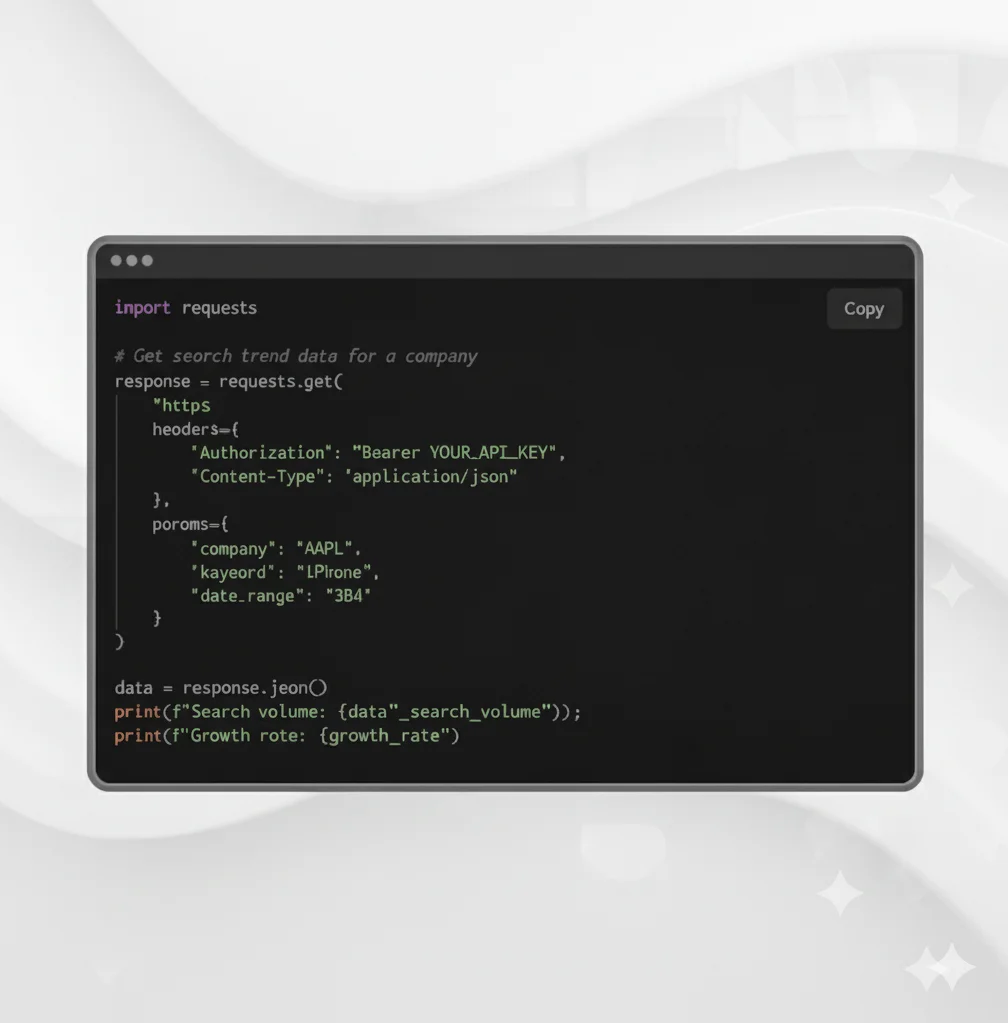
- Structured API access. For systematic strategies, monitoring workflows, or AI-integrated research tools, data needs to be accessible programmatically with defined update schedules and stable endpoints.
Paradox Intelligence provides search and digital behavioral data across Google Search, Google News, Google Shopping, YouTube, TikTok, Amazon, Wikipedia, and news sentiment. Data is normalized on a consistent 0-100 scale with absolute volume estimates, mapped to listed companies, and available via platform, REST API, and MCP server. For a full list of datasets, see Datasets.
When Google Trends is still useful
Google Trends is not useless for investment research. It is a good tool for:
- Quick sanity checks on whether a term has any search presence at all
- Initial exploratory work when building a thesis on a new sector or theme
- Communicating trend direction in a presentation where a visual chart matters more than precise methodology
- Validating a directional view with a free, publicly verifiable source
The gap is in systematic, repeatable, investment-grade use. For occasional exploratory work, Google Trends is fine. For monitoring workflows, factor construction, pre-earnings data prep, or any process that needs to run consistently and produce comparable outputs over time, you need something more structured.
Other tools that extend Google Trends
Several tools build on or complement Google Trends for specific purposes:
- Glimpse adds absolute search volume estimates to Google Trends data and smooths the visualization. Better for consumer and marketing use but still a single-source, single-platform tool without ticker mapping.
- Exploding Topics uses Google Trends (and other signals) to surface rising topics for content and marketing use. Not designed for investment workflows or ticker mapping.
- SEMrush / Ahrefs provide keyword volume and SEO data, useful for digital marketing. Not built for investment research or company mapping.
None of these solve the ticker mapping, multi-source normalization, or API requirements that institutional use demands.
For a comparison of alternative data platforms that address these gaps, see Best Alternative Data Platforms 2026. For a look at how behavioral signals fit into a broader alternative data strategy, see 5 Alternative Data Sources Hedge Funds Use Most.
Explore the data
This post is for institutional investors and research professionals. It is not investment advice.