

AI assistants have moved from summarizing documents to executing research workflows. In 2026, the most forward-looking investment teams are wiring AI tools directly into live alternative data feeds, allowing a portfolio manager or analyst to ask a natural language question and receive a response grounded in real behavioral signals. This post explains how that works, what it requires, and where Paradox Intelligence fits.
What changed: from document retrieval to live data access
For most of their early history, AI assistants in investment contexts were used for document work: summarizing earnings transcripts, extracting key points from research reports, drafting memos. That capability is valuable, but it still depends on the analyst to supply the document. The AI is a reading accelerator, not a research engine.
The shift came with the Model Context Protocol (MCP), an open standard that allows AI assistants to connect to external data sources, APIs, and tools in real time. With an MCP connection, an AI like Claude can query a live data feed, pull a time series, and incorporate that data into a response without the user uploading anything. The assistant becomes capable of answering questions that require current data, not just questions that require reading text.
For investment research, this is the difference between: "Summarize what this transcript says about demand" and: "Pull the search trend for this company's core product for the last 12 weeks and tell me whether it's tracking above or below the prior-year period."
What AI assistants can do with alternative data
When an AI assistant is connected to a live alternative data source via MCP, it can answer questions that were previously only answerable by a trained data analyst with platform access. Examples:
Pre-earnings demand checks "What does search trend data say about consumer demand for [company] over the last quarter? Is it tracking above or below a year ago?"
Thematic screening "Which themes or categories have seen the largest acceleration in search and social engagement in the last 30 days?"
Competitive signal comparison "Compare search trend momentum across [Company A], [Company B], and [Company C] in the [sector] category."
Risk monitoring "Has news sentiment for [company] shifted materially in the last two weeks? What direction and how large is the move?"
Inflection detection "Which companies in my watchlist are showing the largest divergence between recent search trend growth and current consensus estimates?"
None of these require the analyst to download a file, log into a platform, or write a line of code. The AI assistant handles the query execution, data retrieval, and synthesis in a single step.
Stay up to date on our best ideas
How MCP connections to alternative data work
An MCP server sits between an AI assistant and a data source. When an AI like Claude is configured with a Paradox Intelligence MCP server, it can call the server's available tools as part of a conversation. The user asks a question; the AI determines what data it needs; it calls the MCP tool; it receives structured data back; and it incorporates that data into a grounded response.
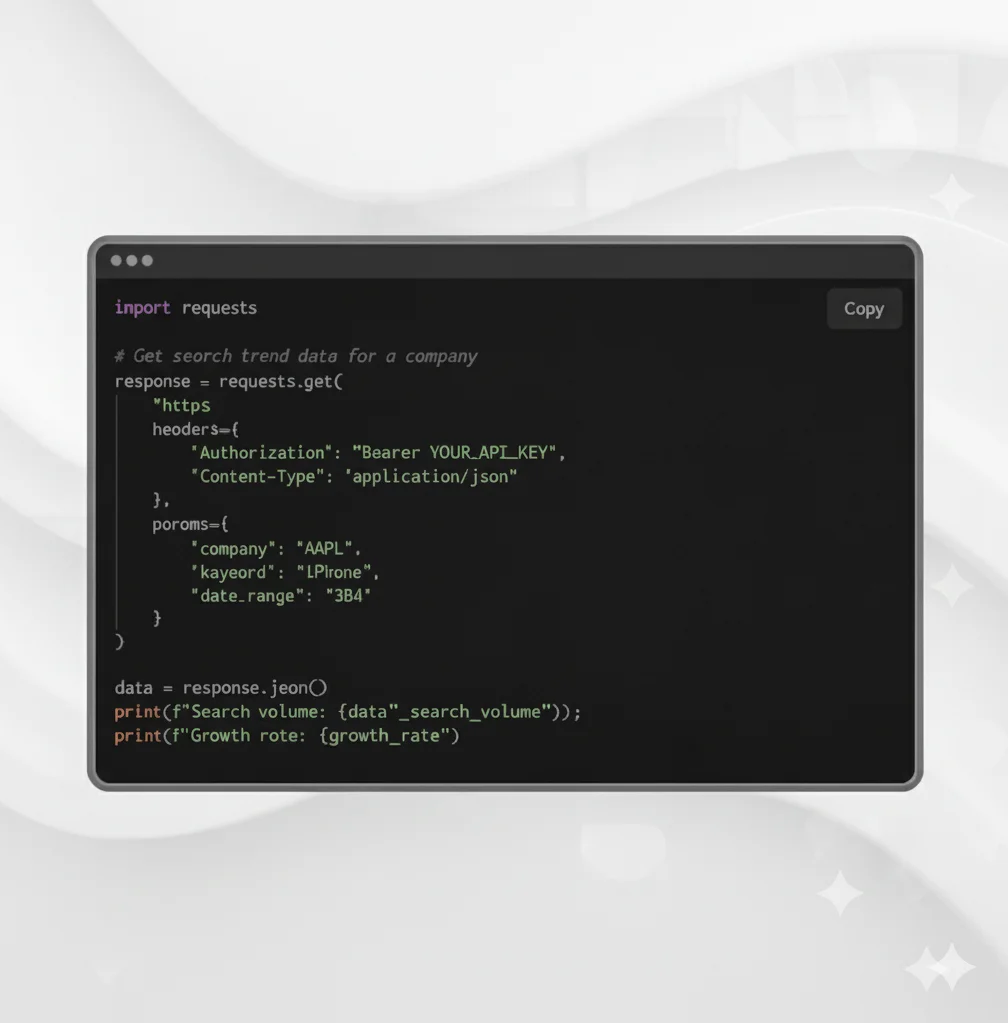
The MCP server defines what tools are available: what queries can be made, what parameters they accept, and what format the results come back in. For alternative data, this typically means tools like: get trend data for a ticker, rank companies by signal momentum, return top growing themes, or compare signals across a set of symbols.
The result is that the AI's response is grounded in real data retrieved at query time, not in training knowledge that may be months or years old.
Which AI assistants support MCP
The MCP standard is supported by several major AI systems. As of 2026:
- Claude (Anthropic) — Supports MCP natively in Claude Code and Cowork environments. An MCP server can be configured so that Claude has access to live data tools throughout a session.
- Cursor and other coding-focused tools — MCP support is standard in many AI coding environments, which investment teams sometimes use for quantitative research workflows.
- OpenAI ecosystem — Plugin and function-calling frameworks enable similar patterns, though MCP as a specific standard has its own adoption curve.
For institutional investment teams, Claude and MCP represent one of the most accessible paths to AI-integrated data workflows that do not require a custom engineering build.
Where Paradox Intelligence fits
Paradox Intelligence provides an MCP server that connects AI assistants directly to its behavioral alternative data. This includes:
- Search trend signals (Google, Amazon, YouTube, Google Shopping)
- Social engagement signals (TikTok, Reddit)
- News sentiment (normalized, ticker-mapped)
- Web traffic signals
- Wikipedia and reference interest
When a Paradox Intelligence MCP server is configured, an AI assistant can call live data queries against any of these signal categories for any covered symbol or theme. The response the AI gives is grounded in that data, not in general training knowledge about markets.
This means an analyst using Claude in a Cowork or research session can ask questions about real behavioral signals for specific companies and receive answers that are current, structured, and actionable, without switching platforms or exporting files.
For details on the MCP integration: Datasets.
The alternative: ungrounded AI responses
Without a live data connection, an AI assistant answering investment questions is operating from training data that has a cutoff date. It can describe how search trends work as a signal type, but it cannot tell you what the search trend for a specific company has done in the last four weeks. For qualitative work — writing, summarizing, comparing frameworks — this is fine. For empirical questions about current market conditions, it is not.
The value of grounding AI in live alternative data is precisely this: it converts qualitative capabilities (reasoning, synthesis, natural language output) into quantitative-grade research outputs. The AI is still doing the thinking; the data connection ensures the thinking is based on current facts.
How investment teams are building AI-native research workflows
The teams moving fastest on this in 2026 are using AI assistants not as standalone tools but as orchestration layers: the AI receives a research question, determines what data to pull, calls the relevant tools, synthesizes the result, and generates a structured output the analyst can act on.
A typical workflow might look like:
- Analyst opens a session with Claude
- Claude has access to Paradox Intelligence signals via MCP
- Analyst asks: "Which names in my consumer watchlist are showing accelerating search demand and positive news sentiment momentum heading into earnings?"
- Claude queries Paradox Intelligence for search trend and sentiment data across the watchlist
- Claude ranks the names by the requested criteria and produces a brief with the top candidates and supporting data
This workflow replaces what previously required: platform login, manual data export, spreadsheet construction, and written interpretation. The same output is produced in a fraction of the time.
Considerations for institutional teams
Data quality matters more than model quality. An AI assistant is only as useful as the data it has access to. Using normalized, historically consistent, ticker-mapped signals is the prerequisite for this to work well. Raw, inconsistent, or poorly mapped data will produce inaccurate responses regardless of the AI's capability.
MCP is a setup, not a subscription. Connecting an AI assistant to a data source via MCP requires a one-time configuration step. For most investment teams, this is a short technical setup, not a long engineering project.
Audit the responses. AI-synthesized outputs should be reviewed for accuracy, particularly when quantitative conclusions are being drawn. The AI may misinterpret a parameter, apply an incorrect date range, or make an inference that needs checking. Treat outputs as drafts that require analyst sign-off, not as final answers.
Related reading
- MCP Servers for Alternative Data: A Guide for Investment Teams
- AI Investment Agents and Alternative Data
- Alternative Data API Guide for Investors
- Research
This post is for institutional investors and research professionals. It is not investment advice. Product details are subject to change; verify with providers directly.