


Google Trends is widely used in investment research because it is fast and accessible. The problem is that it was not designed as an institutional signal platform.
For investors, the biggest limitation is simple: Trends provides indexed relative interest, not true absolute volume. That makes cross-keyword comparison, cross-region normalization, and model calibration harder than it needs to be.
This guide explains what to use instead when you need stronger signal quality.
Where Google Trends falls short for investment workflows
Google Trends can still be useful for directional checks. It becomes weak when teams need production-grade research.
Key limitations:
- relative index values instead of absolute counts
- limited depth for robust historical feature engineering
- weak mapping from keyword behavior to investable entities
- no native multi-source workflow with social, app, web, and sentiment data
For discretionary teams this creates interpretation ambiguity. For quant teams it introduces avoidable noise.
What an investor-ready alternative should provide
When evaluating Google Trends alternatives, prioritize:
1) Absolute and comparable volume metrics
Absolute search volume supports better ranking, weighting, and cross-topic comparison.
2) Source diversification
Search behavior is stronger when paired with other channels:
- Amazon search for commerce intent
- YouTube and social for attention velocity
- web and app behavior for conversion signals
3) Investable mapping
You should be able to move from signal to:
- company
- ticker
- sector or thematic basket
without manual cleanup every time.
4) Monitoring and alerting
The goal is not only historical analysis. You also need to detect inflections early with watchlists and alerts.
Stay up to date on our best ideas
Practical use cases where alternatives outperform Trends
Earnings demand nowcasting
Absolute, multi-source demand signals often produce clearer pre-earnings reads than a single indexed Trends series.
Competitive share-shift monitoring
Comparing multiple brands across search and engagement sources gives a better view of momentum changes.
Thematic rotation detection
When narrative and behavior move together across search, social, and news, teams can detect regime changes earlier.
Google Trends for stocks: what investors are actually looking for
Two recurring query variants are especially important for this topic:
- google trends for stocks
- google trends stock market prediction
These queries usually mean: "Can I turn search behavior into a repeatable stock research signal?"
The answer is yes, but not with raw Google Trends alone. For stock workflows, investors typically need:
- absolute volume context (not only 0-100 index values)
- company or ticker mapping
- cross-source confirmation (search + social + web + news)
- watchlist-based monitoring and alerts
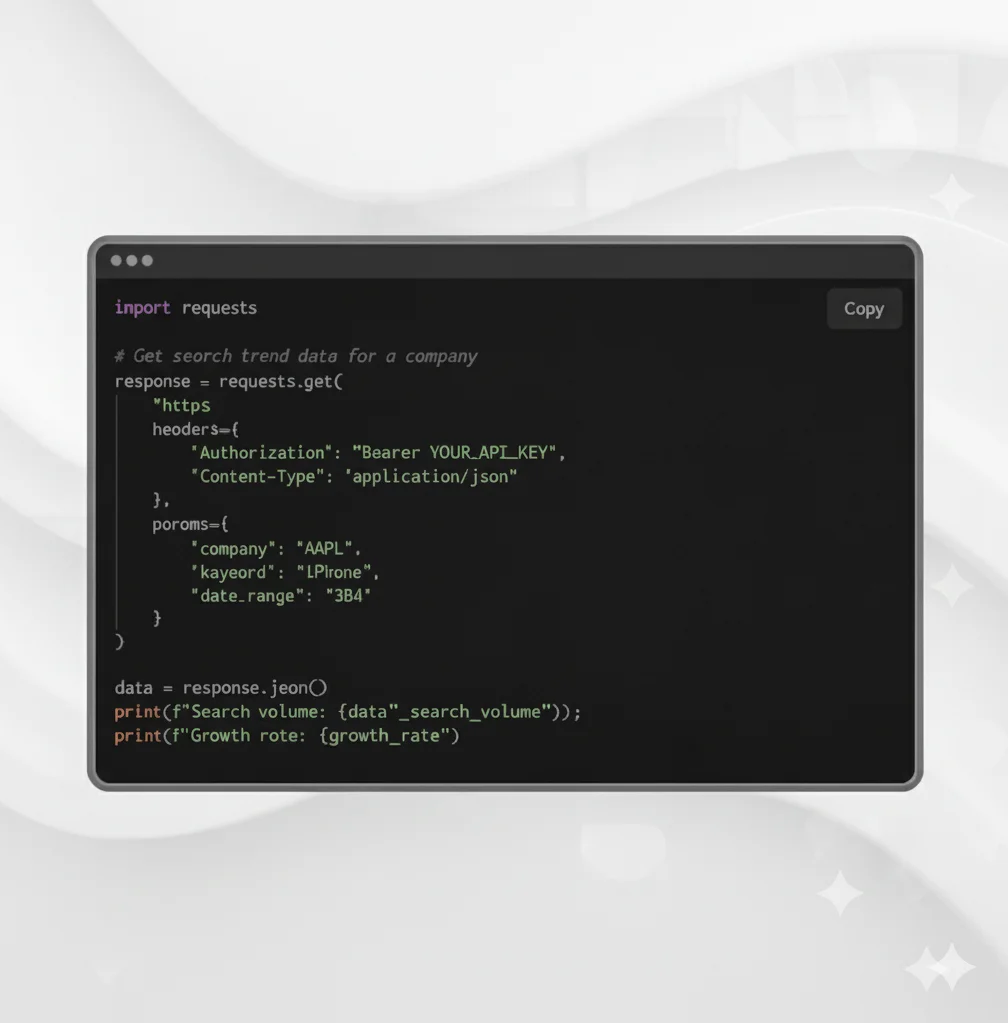
- programmatic access for model and AI-assisted research workflows
When a platform provides those five pieces, it becomes a genuine Google Trends alternative for investors instead of a keyword charting tool.
A simple migration path from Google Trends
- Keep Trends for quick exploratory checks
- Replace core production signals with absolute, mapped datasets
- Add one additional behavioral source first (for example app or social)
- Build watchlists around your current coverage universe
- Validate impact on your research cycle time and conviction scores
This keeps transition cost low while improving signal reliability.
Where Paradox Intelligence fits
Paradox Intelligence gives investment teams multi-source behavioral intelligence with company mapping and monitoring workflow built in. This allows analysts to move from trend detection to investable insight without stitching disconnected tools.
You can review Datasets, integrate through APIs, or book a demo.
Related reading
- Google Trends for Investment Research: Key Limitations in 2026
- Alternatives to Google Trends for Investment Research
- Amazon Search Intelligence for Investors