

Sign Up
Datasets Use Cases Research
Sign Up
Insights

Alternatives to Google Trends for Investment Research in 2026: The Complete Institutional Guide

Google Trends is free but broken for institutional use. This guide covers every serious alternative for investors who need absolute volumes, multi-platform coverage, ticker mapping, and historical consistency.

Google Trends is where most investment teams start when they want to use search data. It is free, fast, and visually intuitive. And for a quick sanity check or a press-friendly chart, it is fine. But the moment you try to use it seriously, as a repeatable, normalized input into an investment process, it fails in six different ways.

This guide explains exactly why, what the best alternatives are, how they compare across the dimensions that matter institutionally, and why the gap between consumer-grade trend tools and institutional-grade behavioral data has never been wider.


These are not minor inconveniences. They are structural limitations that make Google Trends unsuitable as a systematic investment input.

1. Relative indexing only, no absolute volume

Every output from Google Trends is a 0-100 index where 100 represents the peak within your selected time window. There is no absolute volume behind the number.

This means: - You cannot compare two different search terms to each other. A score of 70 for "Nike" and 70 for "On Running" tells you nothing about relative search volumes because they are each indexed to their own peak. - You cannot track whether search volume has actually grown. If demand for a product doubles but the composition of the search mix shifts, the index may not reflect it. - You cannot screen a universe of companies by search volume because there is no common unit to screen on.

For investors who need to know whether a company is capturing more or less consumer demand than its peers, this limitation alone disqualifies Google Trends as a systematic input.

2. Normalization changes when you change your query

The same keyword will produce different results depending on the time range you select, the geography, and whether you include related terms. The peak shifts, and with it, the entire historical series.

This makes longitudinal analysis unreliable. A signal you track week over week may show a different pattern simply because Google recalculated the index after you added a comparison term. For a repeatable investment process, a data input that changes its own history when you query it differently is not usable.

3. Single platform: Google Search only

Consumer intent and behavioral data does not live only on Google Search. Depending on the category:

  • Amazon captures product purchase intent. A consumer who searches for running shoes on Amazon is further along the purchase funnel than one doing a Google web search.
  • YouTube captures discovery and research behavior. Video search is one of the fastest-growing discovery channels and is a leading indicator for categories from consumer electronics to travel.
  • TikTok captures social discovery and cultural momentum. For many consumer brands, TikTok trends precede Google searches by days or weeks.
  • Reddit captures community discussion and niche interest that often precedes mainstream adoption.
  • Google Shopping captures active comparison shopping, a higher-intent signal than general web search.

A fund tracking only Google Search is looking at one dimension of a multi-dimensional behavioral landscape. The most valuable insights often come from seeing when multiple platforms move together or diverge.

4. No ticker or company mapping

Google Trends gives you a keyword. It does not tell you which publicly traded company that keyword is associated with, which sector it belongs to, or how to run a screen across a defined universe.

Mapping "running shoes" to NKE, ONON, DECK, and SKX is manual work. Mapping hundreds of brands and products to their parent companies, accounting for subsidiaries, brand aliases, and private label variants, is not a weekend project. It requires a structured taxonomy built and maintained by people who understand equity research.

Without this mapping, search data stays in the world of marketing analytics, not investment research.

5. No reliable API for systematic use

Google offers a Trends API, but it is not a public, documented, stable API in the way institutional data providers offer APIs. Rate limits are unpredictable, outputs are inconsistent with what you see in the UI, and building a reliable pipeline on top of it requires significant engineering effort and ongoing maintenance.

Institutions that have tried to build internal pipelines on raw Google Trends data consistently report that maintenance costs are high and data quality is inconsistent. There are third-party services that wrap the API and improve reliability, but they inherit the fundamental limitations of the underlying data.

6. Sampling noise on low-volume terms

For less-searched keywords, Google Trends uses sampling that introduces noise. Querying the same low-volume term on the same day can produce different results. For systematic work where consistency and reproducibility matter, this sampling noise is a real problem.


What an institutional-grade alternative must provide

Any replacement for Google Trends in an investment workflow needs to solve all six problems above. Here is the evaluation framework:

Requirement Why it matters for investment use
Absolute volume estimates To compare demand across companies, run screens, and measure magnitude of change
Consistent normalization So historical analysis is stable and does not change when you change the query
Multi-platform coverage To capture the full behavioral signal, not just one channel
Ticker and company mapping To connect trends to your investable universe
Historical depth (5+ years) For backtesting, seasonality adjustment, and signal validation
Programmatic API access For systematic use in models, pipelines, and monitoring workflows
MCP or AI-native access For integration with modern AI-assisted research tools

Stay up to date on our best ideas

The alternatives: a comprehensive comparison

1. Paradox Intelligence

The institutional-grade answer to every Google Trends limitation.

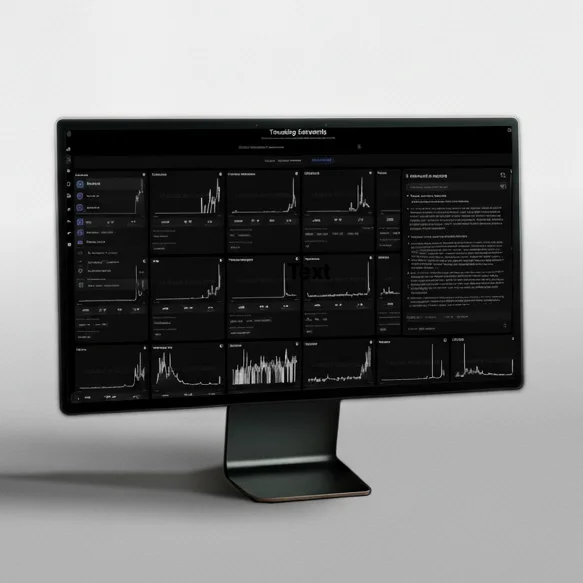
Paradox Intelligence is purpose-built for professional investors. It covers 20+ datasets across every major behavioral signal platform, normalized on a consistent methodology, mapped to 50,000+ companies globally, and accessible via platform, REST API, and MCP server.

Datasets available: - Google Search trends (absolute volume estimates, consistent normalization) - Google News volume and sentiment - Google Shopping (active commercial intent) - Google Images - YouTube search and video intelligence - Amazon product search (purchase intent) - TikTok engagement and hashtag signals - Reddit community discussion - X/Twitter sentiment - Instagram engagement - Facebook - Pinterest - Wikipedia page views - Web traffic analytics - Podcast mentions - ChatGPT search trends - Baidu (China coverage) - News sentiment (structured scoring)

Why it leads on every dimension:

On absolute volume: Paradox provides estimated absolute volume, not just a relative index. You can compare demand levels across companies and track whether absolute interest is growing or contracting.

On normalization consistency: The methodology is fixed. Historical data does not change when you add a new comparison or change your time window. This makes longitudinal analysis valid and backtesting possible.

On multi-platform coverage: No other platform covers as many behavioral signal types in one place. A fund researching a consumer brand can simultaneously look at Google Search trends, Amazon purchase intent, TikTok viral momentum, and Reddit community discussion, all mapped to the same ticker, in one workflow.

On ticker mapping: 50,000+ companies mapped globally. You can screen by company, sector, or theme. This is what turns trend data into investment data.

On historical depth: 20+ years of historical data across key datasets. Long enough to backtest through multiple cycles and adjust for seasonality.

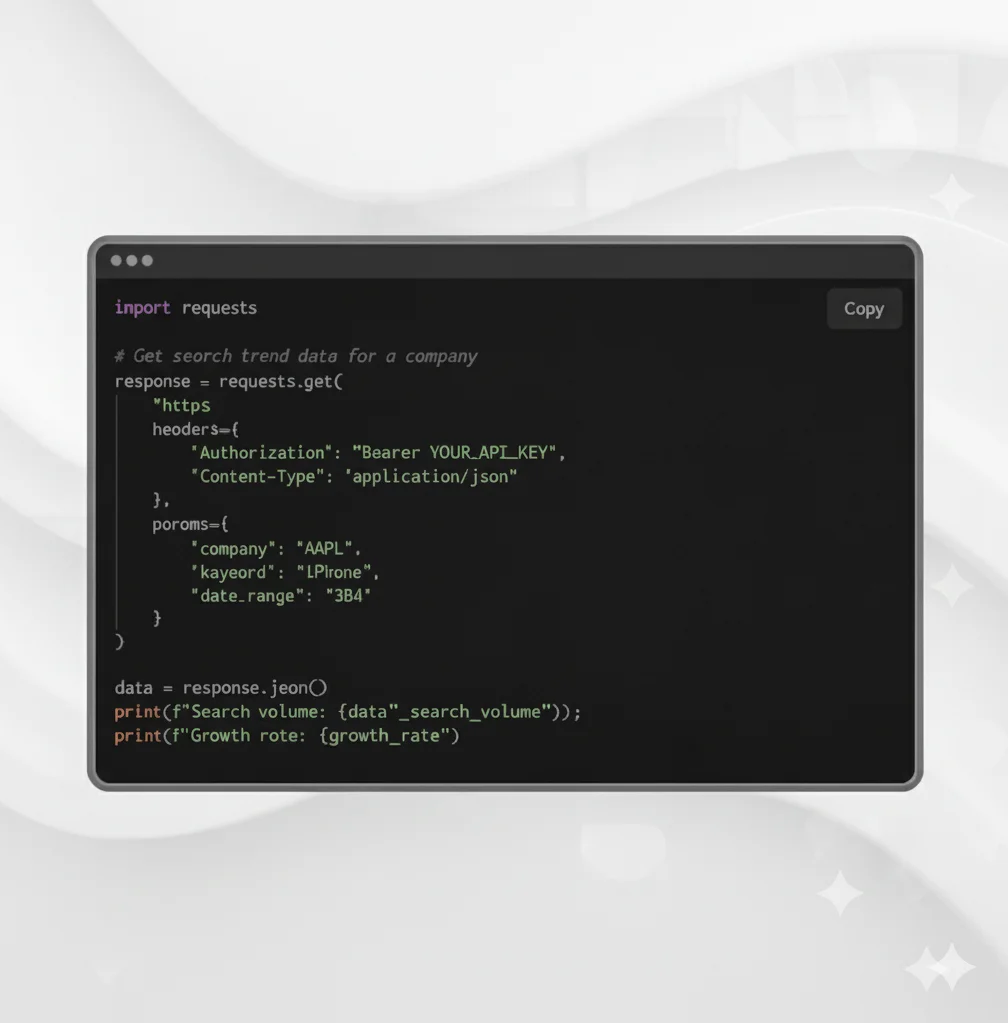
On programmatic access: REST API with institutional-grade reliability, plus MCP server access so AI agents and tools (Claude, Cursor, custom research systems) can query alternative data in real time.

On coverage breadth for conviction: This is where the gap between Paradox and every other tool on this list is widest. When you are building conviction on a company or theme, you do not want one signal, you want corroboration. A search trend up on Google and also rising on Amazon, with TikTok engagement accelerating and Reddit discussion increasing, is a fundamentally different and more actionable signal than any single-platform reading. Paradox is the only platform where you can do all of that in one place, on a consistent scale, mapped to your coverage universe.

Explore Paradox Intelligence datasets | Book a demo | Find Your Plan


2. Glimpse

Best for: teams that specifically want to convert Google Trends into absolute search volume

Glimpse wraps Google Trends and converts the relative 0-100 index into estimated real search volume. It is a meaningful improvement on raw Google Trends because it solves the absolute volume problem.

What it solves: Absolute volume estimates for Google Search. Real-time data. API access. Much more reliable than building directly on top of Google's unofficial API.

Where it falls short: - Google Search only. No Amazon, YouTube, TikTok, Reddit, or other platforms. - No ticker or company mapping for investment use. - No news sentiment or social signal coverage. - Pricing is usage-based and can become expensive at scale for a broad coverage universe.

Glimpse is a good choice for teams that specifically need absolute Google Search volume and are comfortable building their own mapping and multi-source data aggregation on top. For teams that want a complete institutional workflow out of the box, it is a building block, not a solution.


3. YipitData (now Vista Data)

Best for: consumer and retail funds needing transaction and spending data

YipitData is one of the most-cited alternative data providers for consumer research. Their core strength is transaction and receipt-level data: what consumers are actually buying, with enough granularity to estimate revenue ahead of earnings.

What it solves: Consumer spending data with high predictive power for retail and consumer discretionary names. Absolute volume, historical depth, company-level mapping.

Where it falls short for the Google Trends use case: - Transaction data, not search or behavioral data. Different question answered. - Very expensive, typically high six figures annually for full access. - Not purpose-built for search trends, social signals, or multi-platform behavioral analysis.

YipitData is an excellent complement to search and social data, not a replacement for it. A fund running both would have meaningfully more conviction than one running either alone.


4. SimilarWeb

Best for: web and app traffic analysis for digital-first companies

SimilarWeb provides estimated website traffic, app download and usage metrics, and digital engagement data. For technology, SaaS, e-commerce, and marketplace companies where web and app activity is a direct proxy for revenue, SimilarWeb is a strong tool.

What it solves: Absolute volume estimates for web traffic. Good competitive benchmarking. App intelligence. Investor-oriented product tier.

Where it falls short: - Primarily web and app. Does not cover Amazon search, TikTok, Reddit, Google Search, or news sentiment. - No structured search intent signal across non-web channels. - Accuracy drops for smaller websites where their panel has limited coverage.

SimilarWeb is best used as one component of a multi-source stack, particularly for technology and digital-first equity coverage.


5. Bloomberg Alternative Data (via Terminal or Data License)

Best for: teams deeply embedded in the Bloomberg ecosystem

Bloomberg distributes alternative data, including search-related and digital datasets, through the Terminal and Bloomberg Data License. The value proposition is integration with Bloomberg's existing identifiers, workflows, and compliance infrastructure.

What it solves: Institutional compliance and workflow integration for teams already in Bloomberg. Entity mapping uses Bloomberg identifiers.

Where it falls short: - The search and social data is typically sourced from third-party vendors and resold, not built by Bloomberg itself. Coverage and freshness depends on the underlying vendor relationship. - Expensive as a fully bundled solution. - Less flexible for teams building their own pipelines or using non-Bloomberg tooling.

For Bloomberg-centric shops that want to add alternative data without changing their workflow, this is a legitimate option. For teams building a best-of-breed data stack, going direct to primary providers usually wins on coverage, freshness, and price.


6. Thinknum

Best for: fundamental analysts tracking web-observable company signals

Thinknum collects and structures data from public web sources: job postings, product listings, app ratings, pricing data, and related signals. It is observational (what companies are doing) rather than behavioral (what consumers are doing).

What it solves: Early signals on company operations and strategy from web-observable sources. Useful for detecting hiring trends, product expansion, and competitive moves.

Where it falls short for the Google Trends use case: - Not a demand or consumer sentiment platform. - Does not provide search, social, or multi-platform behavioral data. - Less useful for pre-earnings demand analysis or consumer brand research.

Thinknum occupies a distinct niche. It is not a Google Trends alternative in any meaningful sense; it answers different questions.


How to choose: a decision framework

The right tool depends on what you are actually trying to answer.

If you want to know whether consumer demand for a product or brand is growing or contracting, and you want to see that across Google Search, Amazon, TikTok, YouTube, and Reddit simultaneously, mapped to the relevant tickers, with a consistent historical series you can backtest: Paradox Intelligence is the only platform that does all of this in one workflow.

If you specifically need absolute Google Search volume and are comfortable building ticker mapping yourself: Glimpse is a strong building block.

If you need web and app traffic specifically for digital-first companies: SimilarWeb is the standard.

If you need consumer spending and transaction data: YipitData is the leader.

If you are in Bloomberg and want to stay there: Bloomberg Alternative Data.

Most institutional teams end up using more than one. The combination that appears most frequently in well-resourced research processes is search/social behavioral data plus transaction data, because they measure different things (intent vs. completion) and corroborate or contradict each other in informative ways.


The practical reality of multi-platform search data

One point worth emphasizing before closing: the real edge in behavioral data is not any single platform but the relationship between platforms.

When a brand's Google Search trends are rising moderately but its Amazon search volume is rising sharply, that is a high-conviction demand signal. The consumer is moving from awareness to purchase intent.

When TikTok engagement around a brand surges but Google Search does not follow within 72 hours, that is a red flag. The viral moment is not converting to organic interest, which is a historically bad sign for whether the trend has legs.

When Reddit discussion of a company is rising while news sentiment is falling, you have a case where retail community interest is diverging from institutional narrative, which historically creates a specific type of opportunity.

None of these analyses are possible with Google Trends alone. They require normalized, consistently scaled data across multiple platforms, mapped to the same tickers. That is what Paradox Intelligence provides and what nothing else on this list does in a single workflow.


Many investors do not search with institutional wording. They search with practical variants like:

  • "google trends for stocks"
  • "google trends stock market prediction"
  • "best google trends alternative for investors"

These queries are not asking for general SEO tooling. They are asking for an investable workflow:

  1. map keyword behavior to listed companies
  2. compare relative strength across multiple data channels
  3. monitor changes continuously with alerts or watchlists
  4. export into API-first research workflows

This is exactly where Google Trends breaks down and multi-signal investment platforms win.

Workflow requirement Google Trends Paradox Intelligence
Find emerging stock-relevant keywords quickly Partial (manual keyword by keyword) Yes (Catalyst Search + Top Trends)
Connect trend shifts to investable companies No native ticker mapping Yes (Company Trends, mapped company workflows)
Compare signals across multiple datasets Limited and manual Yes (Analyse, cross-source comparison)
Monitor a coverage universe over time Manual exports and re-checks Yes (My Watchlist, ongoing monitoring)
Detect live momentum inflections Limited Yes (Live, real-time trend monitoring)
Feed signals into models and AI research tools Unofficial/limited Yes (REST API + MCP)

If your core query is "google trends alternative for stocks," the useful answer is not another single-source keyword chart. The useful answer is a mapped, multi-source, monitorable workflow that supports actual investment decisions.


Summary comparison

Platform Absolute volume Multi-platform Ticker mapping API Best for
Paradox Intelligence Yes (20+ datasets) Yes (Google, Amazon, TikTok, Reddit, YouTube, X, Instagram, Wikipedia, and more) Yes (50,000+ companies) Yes + MCP Full institutional behavioral data workflow
Glimpse Yes (Google only) No No Yes Google absolute volume conversion
YipitData Yes (transactions) No Yes Yes Consumer transaction data
SimilarWeb Yes (web/app) Partial Partial Yes Web and app traffic
Bloomberg Alt Data Varies by dataset Partial Yes (BBID) Yes Bloomberg-embedded teams
Thinknum Partial No Partial Yes Web-observable company signals
Raw Google Trends No No No Unofficial Quick visual checks only

Further reading


Explore Paradox Intelligence


This post is for institutional investors and research professionals. It is not investment advice. Product details are subject to change; verify with providers directly.

Share

Get insights delivered

BUILT BY INVESTORS, FOR INVESTORS